
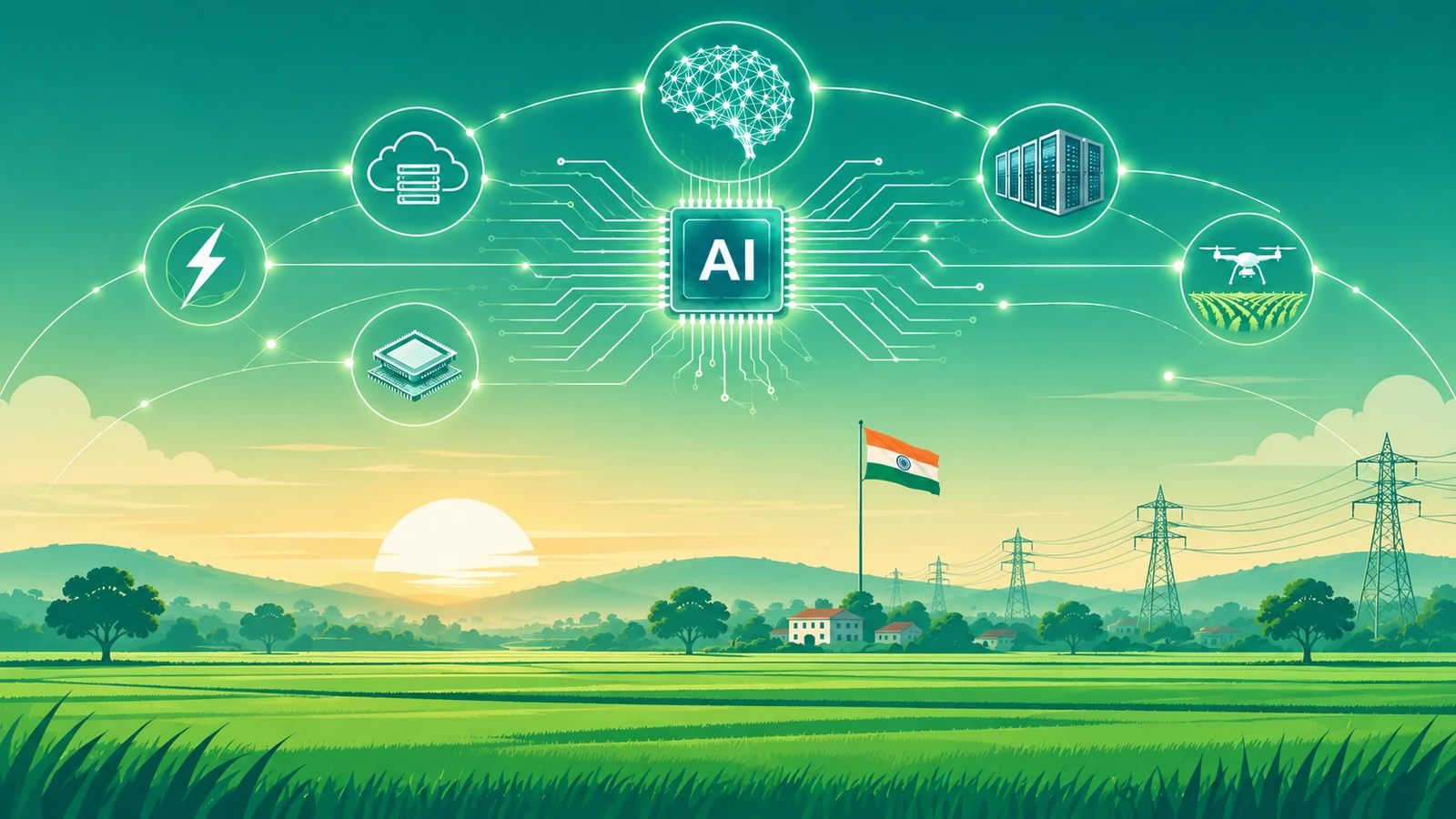
India wants to be a force in AI. This ambition is backed by a huge pool of engineers, a massive digital population, huge amounts of data and increasing public investment in computing and semiconductors. But behind the optimism lurks an uncomfortable question: how much of India’s AI future will actually belong to India?
A country can build great AI apps, but depend on foreign companies for the chips, cloud infrastructure, software and computing power that enable those apps. India’s semiconductor ecosystem is expanding, with new domestic manufacturing efforts underway. However, it remains dependent on external sources for several advanced components and technologies. The most advanced AI computing systems rely on chips produced by a small number of global companies.
Towards AI Sovereignty
India can train talent and build models, but it requires huge amounts of computing power to train and run them. As of June 2026, the IndiaAI Mission reports a capacity of more than 45,000 Graphics Processing Units (GPUs) in the shared IndiaAI compute ecosystem.
While this is certainly commendable, other layers of the AI stack including advanced hardware and software remains dependent on global supply chains. That distinction could be crucial in a major geopolitical crisis. India may own the AI, but not the full infrastructure that produces it.
To mitigate this dependency, India has been pursuing technological sovereignty. India’s approach to technological sovereignty is not based on complete self-sufficiency.
In the context of India’s AI policy, sovereign AI can instead be understood as the ability to develop, access and operate critical AI capabilities — including models, data, compute and supporting infrastructure — without becoming vulnerable to the decisions of a single foreign provider. The IndiaAI Mission reflects this approach through its support for indigenous foundation models, shared compute infrastructure and India-specific datasets.
At the same time, India sees international partnerships and technology diplomacy as important to securing access to critical technologies, diversifying supply chains and strengthening its technological resilience. India should identify the technology layers whose loss would seriously harm national security and ensure that those layers have either domestic capability or a trustworthy alternative.
Mitigating the Risks from Dependency
What India is striving to avoid is the problem of platform dependency: excessive reliance on a small number of foreign providers for critical computing, cloud services or AI infrastructure, which can leave India vulnerable to changes in access, pricing or provider policies. These risks can be reduced by expanding domestic compute capacity, developing indigenous AI models and diversifying its technology partnerships. The idea is not to manufacture every chip or build the world’s cloud company, but attain sufficient capability and alternatives to ensure that dependence does not become a strategic vulnerability.
Sufficient domestic computing capacity is therefore imperative to keep critical public systems operating if foreign services become unavailable or access conditions change. The question is where vulnerabilities remain and how India can address them. What happens if the GPUs stop arriving? What happens if a cloud provider cuts access? What happens if an important software license is withdrawn? What happens if high electricity costs make large‑scale home computing too expensive? Every question should have a backup plan.
India could maintain reserves of AI hardware, diversify procurement channels, ensure that government AI systems can run across different computing environments, and require that critical public-sector AI tasks can be shifted between domestic computing sites when necessary. The goal is not to shut India off from global technology. It is to ensure that technological dependence cannot dictate India’s strategic choices.
In addition to new missions and funding programs, the government can become an early customer for Indian AI technologies, building on existing public-sector applications of AI. Public-sector institutions can provide domestic markets for Indian companies developing chips, AI models and computing systems. Sectors such as healthcare, taxation, agriculture, transport and public administration could provide opportunities to test and refine these technologies at scale. Government procurement can therefore help domestic companies develop products that are competitive beyond the public sector.
Needed, A Synchronized AI Strategy
AI policy cannot stand alone. It must be coordinated with semiconductor, energy, industrial, data-centre and national-security policy, since weaknesses in one area can constrain progress in another. For example, expanding compute without reliable power creates a bottleneck, while domestic AI models cannot scale without adequate compute, data and talent. These policies therefore need to be planned together if India wants to build strategic resilience in AI.
India should treat electricity and data-centre capacity as part of its AI strategy. India has the potential to become a major destination for data-centre investment, given its large digital economy, growing demand for AI services and expanding technology sector. Realising that potential, however, will depend on addressing constraints around reliable power, cooling, connectivity and physical infrastructure through policy and investment. Running AI systems at scale is impossible without these foundations.
India’s experience with digital public infrastructure, developing Large Language Models in local languages and large-scale public services, including in healthcare, agriculture and public administration also gives it a potential advantage. These affordable models may particularly be attractive for the Global South. That would give New Delhi something additional than technological prestige: market power and bargaining power. A country becomes strategically important not when it can build everything but when other nations start to need what it can make.
Ultimately, India does not need to make every part of the AI ecosystem. It only needs to control enough of it to prevent strategic dependence from turning into a strategic vulnerability. The real test of India’s AI goals is not how many startups it creates or how many GPUs it puts in place, but how resilient its systems remain if access to foreign technology is disrupted. If India can maintain that resilience while building AI capabilities suited to its own needs and the wider Global South, it can become an AI power to reckon with.
Disclaimer: The article expresses the author’s views on the matter and do not reflect the opinions and beliefs of any institution they belong to or of Trivium Think Tank and the StraTechos website.